In the world of research chemicals, few compounds have attracted as much attention as SR9009 and its successor, SR9011. Both compounds may influence metabolism and endurance, making them interesting subjects in preclinical studies. But what are the key differences between SR9009 and SR9011?
This guide will outline the characteristics of these two compounds. We’ll look at their chemical structures, possible benefits, and current research on their effects, dosage, and side effects.
Understanding SR9009 and SR9011
SR9009 (Stenabolic) and SR9011 were developed at the Scripps Research Institute, a leading non-profit biomedical research facility recognized for its innovative work in drug discovery and development. They are not SARMs (Selective Androgen Receptor Modulators) but rather Rev-ErbA agonists.
This means they bind to and activate the Rev-ErbA proteins, which play a key role in regulating the body’s circadian rhythm and metabolism. As described in the foundational research:
“Administration of synthetic REV-ERB ligands alters circadian behaviour and the circadian pattern of core clock gene expression in the hypothalami of mice. The circadian pattern of expression of an array of metabolic genes in the liver, skeletal muscle and adipose tissue was also altered, resulting in increased energy expenditure.” — Solt et al., Nature, 2012
Chemical Structure and Mechanism
Both SR9009 and SR9011 focus on the Rev-ErbA proteins (Rev-Erbα and Rev-Erbβ). These proteins help manage the expression of genes related to energy metabolism, fat storage, and glucose regulation.
By activating Rev-ErbA, these compounds may improve metabolic activity in skeletal muscle. This can lead to increased energy expenditure and endurance. The main difference in their chemical structures is a modification in SR9011 that aims to increase its bioavailability.
As research confirms: “SR9011 and SR9009 suppressed the expression of BMAL1 mRNA in HepG2 cells in a REV-ERBα/β-dependent manner” and “Both SR9011 and SR9009 potently and efficaciously suppressed transcription in a cotransfection assay using full-length REV-ERBα along with a luciferase reporter driven by the Bmal1 promoter.” — Solt et al., PMC, 2012
SR9009 Benefits and Effects
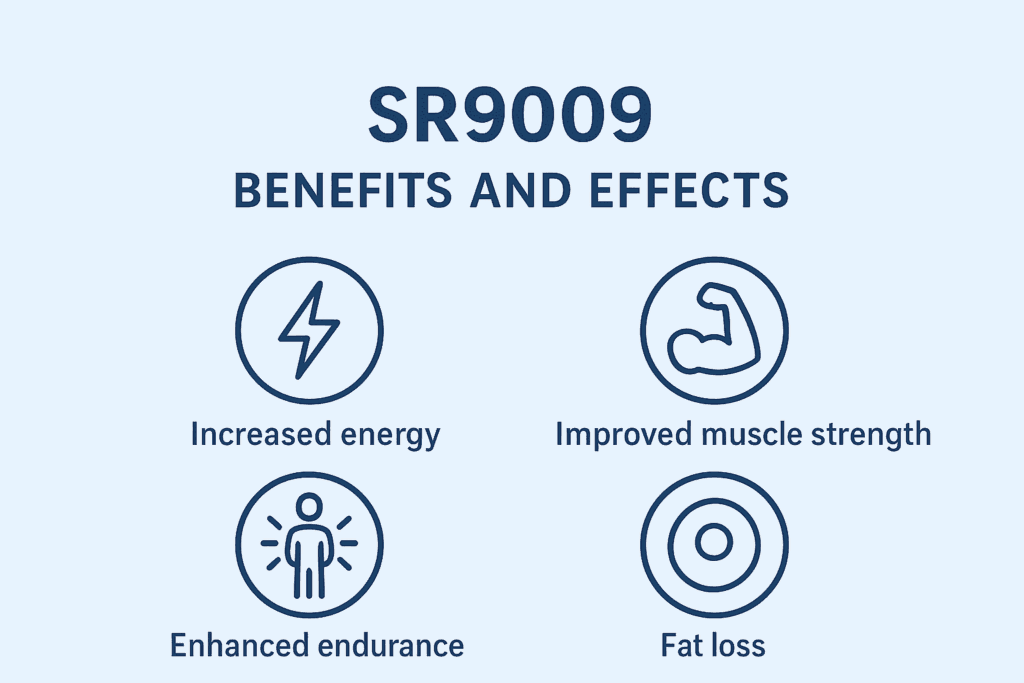
Much of the excitement around SR9009 comes from early animal studies. A review of this research shows several possible benefits of SR9009. In studies with mice, SR9009 was found to:
Increase Endurance
Research published in Nature Medicine demonstrated that:
“The treated mice had a 50 percent increase in running capacity, measured by both time and distance.” — Scripps Research Institute Press Release, 2013.
This finding was supported by researchers at both the Scripps Research Institute and Institute Pasteur de Lille who showed that:
“activation of Rev-erbα with SR9009 led to increased metabolic activity in skeletal muscle in both culture and in mice.” — MedIndia, 2013
Boost Metabolism
The compound raised metabolic activity.
“A 5% increase in oxygen consumption (VO₂) was observed suggesting increased energy expenditure” with SR9011 treatment, indicating that “the increases VO₂ were not due to increased activity since mice displayed a 15% decrease in movement.” — Solt et al., PMC, 2012
Reduce Body Fat
Research indicates significant fat reduction. In obese mice studies:
“SR9009 treated mice exhibited a more severe reduction in adiposity compared with vehicle treatment” and data showed “Mice displayed weight loss due to decreased fat mass.” — NATAP, 2013
Lower Cholesterol
Studies reported substantial improvements in lipid profiles. Specifically, researchers found
“a 12% decrease in plasma triglycerides and a 47% decrease in plasma total cholesterol” in SR9009-treated mice. Additionally, “Plasma non-esterified fatty acids (NEFA) were also reduced (23%) along with plasma glucose (19%) in the SR9009-treated mice.” — NATAP, 2013
These promising benefits earned SR9009 the nickname “exercise in a bottle,” referring to its potential to mimic the effects of exercise on metabolism and endurance. As one researcher noted:
“The animals actually get muscles like an athlete who has been training. The pattern of gene expression after treatment with SR9009 is that of an oxidative-type muscle— again, just like an athlete.” — Scripps Research Institute Press Release, 2013
However, it has a significant limitation due to its poor oral bioavailability, meaning it is not well absorbed when taken by mouth.
SR9011 Effects and Research
SR9011 was designed to solve the bioavailability issues seen with SR9009. It has a slightly changed chemical structure that may allow for better absorption into the bloodstream. Research confirms that
“SR9009 and SR9011 are two potent REV-ERBs agonists designed based on the chemical structure of GSK4112. These two compounds are about threefold more potent and efficacious than GSK4112, and they show better pharmacokinetic properties (may be suitable for in vivo studies).” — Wang, Targeting REV-ERBα, 2020
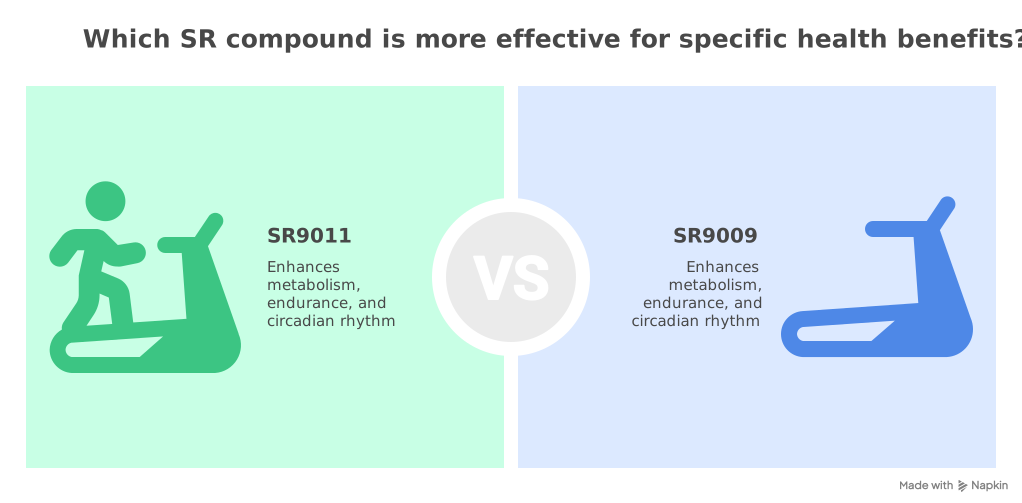
The possible effects of SR9011 are quite similar to those of SR9009 since they share the same mechanism of action. Research suggests that SR9011 might also:
- Enhance metabolic rate and energy production: Studies using comprehensive laboratory monitoring systems demonstrated that SR9011 administration resulted in altered metabolic gene expression and increased energy expenditure in mice.
- Improve endurance and exercise capacity: Research indicates similar endurance-enhancing properties as SR9009 through mitochondrial biogenesis pathways.
- Influence the body’s circadian clock: SR9011 has been shown to modulate circadian rhythms similarly to SR9009, with research demonstrating “reversible inhibition of circadian oscillations in SCN explants cultured from the Per2:luc reporter mouse.” — Solt et al., PMC, 2012
The main benefit of SR9011 is its improved bioavailability, which could make it a more effective compound for research. This advantage gives researchers hope for more efficient and impactful studies in the future.
Key Differences: SR9009 vs SR9011
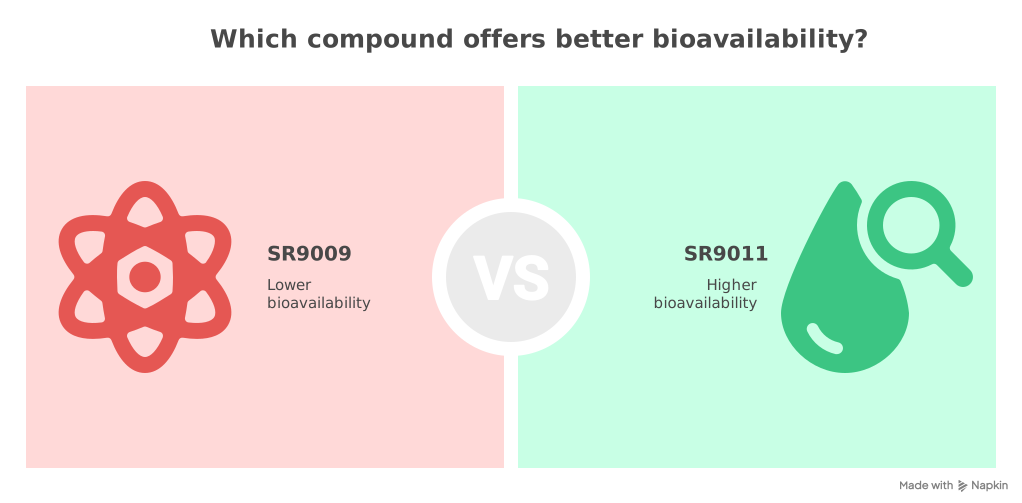
The primary difference between these two compounds is their bioavailability. Bioavailability refers to the portion of a substance that enters the circulation when introduced into the body and becomes available for use or elimination. In simpler terms, it’s about how much of the compound actually gets into your system and starts working.
SR9011 was specifically created to be absorbed more easily by the body than SR9009. The research shows that
“Treatment of mice housed in wheel cages in a L:D setting indicated a delayed onset of physical activity (Fig. 2c) and a similar 1–3h delay in peak VO₂ was observed with administration of SR9011.” — Solt et al., PMC, 2012
In theory, this means that a lower dose of SR9011 could produce effects similar to or greater than those of SR9009. While both activate the same Rev-ErbA pathway, SR9011’s better absorption makes it a more reliable and potent tool for researchers.
Dosage and Cycling
Since neither SR9009 nor SR9011 is approved for human use, there are no official dosage guidelines. In preclinical studies, dosages and cycling protocols for SR9009 varied greatly. Research documenting these parameters showed:
“We examined the metabolic effects of SR9011 in more detail using a comprehensive laboratory animal monitoring system (CLAMS). After acclimation, the animals were administered SR9011 twice per day for 10 days.” — Solt et al., PMC, 2012
Anecdotal reports from online forums mention doses ranging from 10-30 mg per day, often divided into multiple doses due to a short half-life of about 4 hours. SR9011 is less frequently discussed, but because of its higher bioavailability, researchers may use a lower dose to achieve similar results.
Safety, Side Effects, and Legality
The safety profile of these compounds in humans is not known. There have been no clinical trials to assess their long-term effects. Potential side effects of SR9009 are not well-documented, but concerns with any Rev-ErbA agonist may include disrupting the natural circadian rhythm. Research does note that
“similar to SR9011-treated mice, mice treated with SR9009 returned to normal patterns of wakefulness/sleep 12 h after administration.” — Nature Communications, 2014
SR9009 and SR9011 are legal to purchase for research purposes only in most countries. They are not approved for human consumption and are banned by the World Anti-Doping Agency (WADA) for use in competitive sports.
Making an Informed Decision
When comparing SR9009 and SR9011, the main difference lies in bioavailability, with SR9011 being the more advanced compound. Both show potential in animal studies for boosting metabolism and endurance by activating the Rev-ErbA pathway, with research confirming that
“Treatment of diet-induced obese mice with a REV-ERB agonist decreased obesity by reducing fat mass and markedly improving dyslipidaemia and hyperglycaemia.” — Solt et al., Nature, 2012
However, it is important to keep in mind that these are unapproved research chemicals with an unknown safety profile in humans.
Their use outside of a controlled laboratory setting carries significant risks. It’s essential to understand these risks and proceed with caution to ensure responsible and informed decision-making.
References
Solt, L.A., Wang, Y., Banerjee, S., Hughes, T., Kojetin, D.J., Lundasen, T., Shin, Y., Liu, J., Cameron, M.D., Noel, R., Yoo, S.H., Takahashi, J.S., Butler, A.A., Kamenecka, T.M., & Burris, T.P. (2012). “Regulation of Circadian Behavior and Metabolism by Synthetic REV-ERB Agonists.” Comprehensive research demonstrating that SR9009 and SR9011 increase energy expenditure, decrease fat mass, and improve plasma lipid profiles through Rev-ErbA activation in mice. Shows 12% decrease in plasma triglycerides and 47% decrease in plasma total cholesterol in SR9009-treated obese mice. Solt et al., Nature, 2012
Woldt, E., Sebti, Y., Staels, B., Duez, H., & collaborators (2013). “Rev-Erbα Modulates Skeletal Muscle Oxidative Capacity by Regulating Mitochondrial Biogenesis and Autophagy.” Published in Nature Medicine. Documents that SR9009-treated mice had a 50 percent increase in running capacity, measured by both time and distance. Demonstrates that Rev-erbα activation promotes creation of new mitochondria and clearance of defective mitochondria. Scripps Research Institute Press Release, 2013
Wang, S. (2020). “Targeting REV-ERBα for Therapeutic Purposes.” Confirms exclusive actions of SR9009 and SR9011 on REV-ERBs (no effects on other 46 nuclear receptors). Demonstrates REV-ERB-specific efficacy through loss-of-function studies with REV-ERBα-deficient mice. Notes that SR9009 has REV-ERB-dependent effects on cell proliferation, metabolism, and gene transcription. Wang, Targeting REV-ERBα, 2020
Pharmacological Targeting of the Mammalian Clock (2014). “Pharmacological targeting of the mammalian clock regulates sleep behavior.” Research showing that pharmacological activation of REV-ERB led to increased energy expenditure, loss of fat mass, improved plasma lipid profiles, and increased oxidative capacity in skeletal muscle in mice associated with increased exercise endurance. Demonstrates that SR9009 treatment resulted in normal patterns of wakefulness/sleep restoration within 12 hours of administration. Nature Communications, 2014
Related Posts:



The BoostHormone Research Team is a collective of fitness researchers, nutrition specialists, and health science professionals dedicated to providing evidence-based information about hormone optimization and performance enhancement.
With expertise in sports nutrition, endocrinology, and supplement science, our team analyzes peer-reviewed research and clinical studies to deliver honest, science-backed insights. We cut through industry hype to provide the accurate information you need to make informed decisions about your health and performance.
Our mission: translate complex scientific research into practical, actionable guidance – always prioritizing your safety and long-term wellness. Read Our Editorial Guidelines.