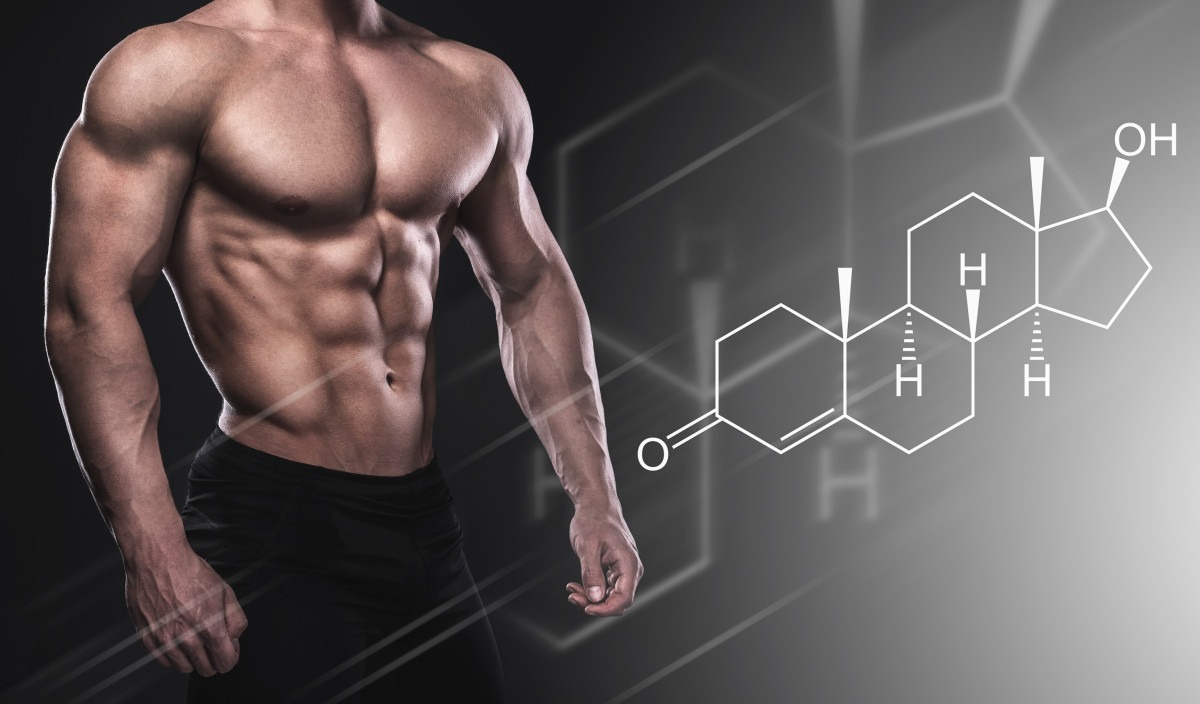
Hormones are substances-signals that are produced by the endocrine system and transmitted with a blood current (humoral) to the organs and cells for their subsequent activation and deactivation.
Hormone molecules can be considered as regulators of almost all metabolic processes in the human body, including those directly related to the quality of life in general and sports performance in particular. The endocrine system of men contains a set of specific steroid hormones, which are called androgens.
The brightest representative of this group is testosterone – the main male sex hormone. Note that androgens are present in the female body, but in smaller amounts. Such hormonal system in males is adapted to the biological functional purpose of a man – a strong warrior, who is agile, fast and enduring. In ancient times such qualities allowed to hunt successfully on animals (to get food), and also to effectively carry out security functions (to fight).
Therefore, men are predisposed to different kinds of sports, in particular to strength sports. The high level of androgens in the blood allows you to easily adapt to increased stress and improve various indicators, whether it be strength, speed or volume of muscle mass.
Classification and Brief Characteristics of Male Hormones
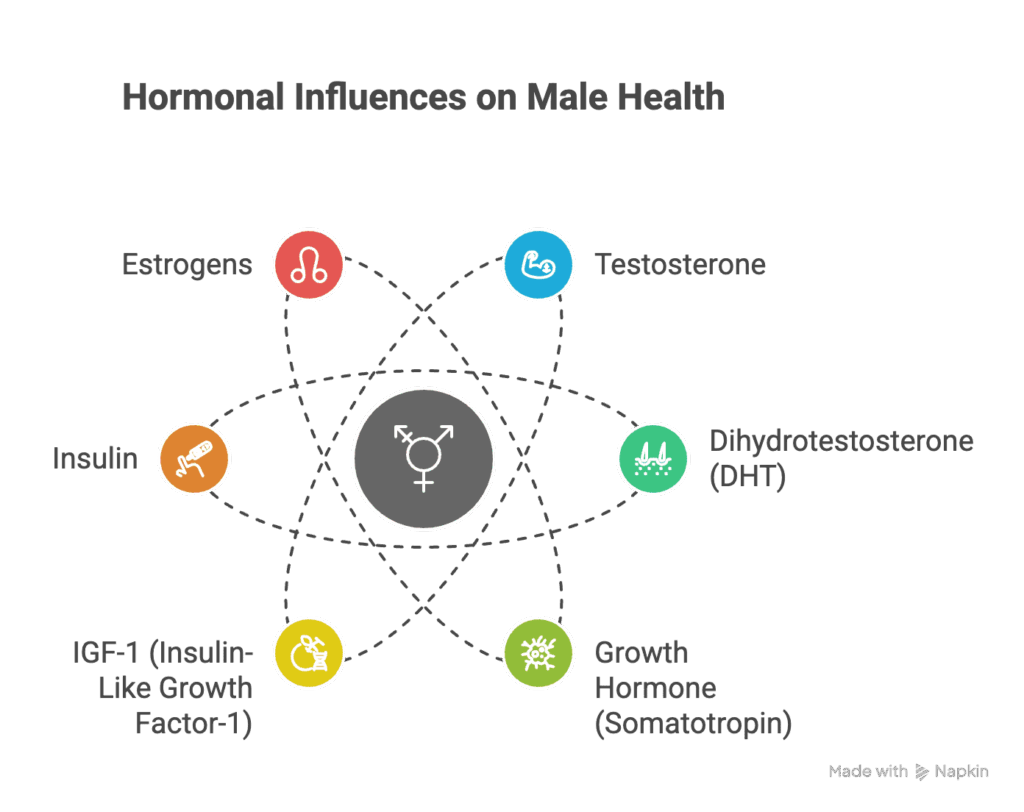
In the male body, many hormones play a direct and indirect role in workout performance in particular and in the quality of life in general. In this section, we will discuss the main hormones and their functions in the male body.
✔️ Testosterone
The main male sex hormone (androgen), which is produced in the testes. It influences the vast majority of organs and cells, including the brain. It is testosterone that forms the main male sex characteristics (male sex) at the stage of embryonic development and fetal embryo bearing by a pregnant woman (from about 12-13 weeks of intrauterine development).
This hormone is also responsible for the development of secondary sexual characteristics at the stage of puberty of a boy, such as voice, male features, muscle mass, body constitution. In terms of training and sports performance, testosterone is involved in nitrogen retention, anabolic processes, fat burning, and suppression of excessive female hormones, which often interfere with peak performance.
According to [Mobley et al., Molecular and Cellular Endocrinology, 2017], a comprehensive review of androgen-mediated muscle protein balance, “androgens significantly alter muscle mass by shifting protein balance in favor of net protein accretion through both stimulation of muscle protein synthesis and inhibition of protein breakdown during catabolic conditions,” establishing testosterone’s critical anabolic role in training-induced muscle adaptation and hypertrophy.
According to [Stanford et al., Endocrinology, 2021], investigating testosterone’s fat-burning mechanisms, “testosterone reduces male fat mass through androgen receptor activation and indirectly increases energy expenditure, while separately the aromatization of testosterone to estrogens stimulates physical activity and fat oxidation through estrogen receptor signaling,” demonstrating dual mechanisms for testosterone-induced body composition improvements.
It also strengthens the ligament system and reduces the risk of injury (due to testosterone deficiency, many older athletes are quite often traumatized, but this is only one factor.)
According to [Quinn et al., Current Orthopaedic Practice, 2024], examining the relationship between testosterone replacement therapy and ligamentous health, “natural testosterone is associated with augmented ACL strength in animal models with higher load-to-failure and ultimate stress measurements, suggesting an important role of testosterone in ligament structural integrity,” though effects of exogenous administration require further investigation for tissue-specific outcomes.
Testosterone affects a man’s quality of life, namely his behavior, reducing impulsivity, stress, and panic feeling. Also, this hormone suppresses the action of some estrogen, so that the man feels much more confident, including the increase of libido and potency.
Normal testosterone levels indicate a man’s health and ability to conceive, i.e. this androgen has a positive effect on spermatogenesis. The development of the male organ depends on testosterone levels at an early age. High testosterone levels normalize blood cholesterol levels, which minimizes the risk of cardiovascular disease.
Testosterone is mostly inactive in the human body because it is bound to the proteins albumin and sex hormone-binding globulin (SHBG). It is the protein-free testosterone that has the above effects.
According to [Goldman et al., Endocrine Reviews, 2017], a comprehensive reappraisal of testosterone’s binding in circulation, “SHBG regulates the bioavailability of circulating sex steroids by binding testosterone with high affinity, while albumin buffers fluctuations through its high binding capacity and concentration, together determining the distribution of circulating testosterone into bound and free fractions available for biological action in tissues,” with recent biophysical analysis revealing allosteric interactions between binding sites that dynamically regulate testosterone’s tissue bioavailability.
✔️ Dihydrotestosterone (DHT)
DHT is another androgen, an active form of testosterone, which is synthesized from it in the body thanks to the action of the enzyme 5-alpha reductase. This process takes place in peripheral cells. Unlike testosterone, DHT binds more actively to receptor cells.
It is DHT that in many ways increases the strength of athletes and promotes muscle mass growth due to many factors, including improved consumption of glucose for energy needs.
According to [Kochakian & Murlin, NIH, 2011], examining DHT’s acute effects on amino acid uptake in muscle fibers, “DHT, but not testosterone, increases amino acid uptake and protein incorporation into fast-twitch muscle fiber bundles through EGFR and MAPK pathway activation,” indicating that DHT is the more potent anabolic metabolite for muscle protein synthesis and amino acid transport compared to testosterone.
According to [Nakamura et al., Journal of Applied Physiology, 2018], investigating DHT’s role in energy metabolism during exercise, “when DHT production during moderate-intensity running was inhibited, whole-body fat utilization was significantly reduced and carbohydrate oxidation substantially increased during the later phase of exercise,” suggesting that DHT plays an important regulatory role in substrate utilization and endurance capacity during athletic performance.
In addition, dihydrotestosterone affects the hair follicles of the head and body.
✔️ Growth Hormone (Somatotropin)
A peptide hormone, which is not related to androgens, is equally synthesized in both men and women. This hormone is necessary for adolescence for pronounced growth of bones, cartilage, and ligaments. Then with years its secretion gradually decreases.
A high level of growth hormone significantly improves the quality of life. This is manifested by the strengthening of the joint-ligament apparatus, nitrogen retention, acceleration of protein synthesis and lipolytic effect (fat burning).
According to [Holt et al., British Journal of Sports Medicine, 2008], reviewing growth hormone’s metabolic effects, “growth hormone causes nitrogen retention through decreased urinary excretion of urea, creatinine and ammonium, and in healthy humans acute GH administration produces significant anabolic effects on protein metabolism and body composition,” supporting its role as a critical anabolic hormone independent of gender in athletic populations.
In general, it is an anabolic hormone of non-steroidal nature, which plays an important role regardless of gender or final training goal.
✔️ IGF-1 (Insulin-Like Growth Factor-1 or Somatomedin C)
The growth hormone affects the receptor cells on its own, but part of it is converted into IGF-1 in the liver, which has a number of other related positive effects. In particular, it is an additional strengthening of bones by improving the absorption of calcium, accelerating metabolism, normalization of protein synthesis and an increase in blood sugar levels, followed by the use of it as an energy source. Thus, IGF-1 acts together with the growth hormone.
According to [Vignali et al., World Journal of Orthopedics, 2014], examining GH and IGF-1’s effects on bone metabolism, “both GH and IGF-1 administration significantly increase bone formation and mineral content in most studies, with IGF-1 playing a central role in cellular growth and differentiation while GH shows synergistic effects when combined with sex steroids in bone development and mass acquisition,” indicating their complementary anabolic mechanisms on skeletal tissue.
✔️ Insulin
The second most important anabolic hormone after testosterone. It also does not apply to steroid hormones. Responsible for the absorption of nutrients by muscle cells and various organs. It has a distinct anti-catabolic and anabolic effect and is several times more effective in doing it than testosterone and DHT.
According to [Chow et al., American Journal of Physiology-Endocrinology and Metabolism, 2006], measuring insulin’s effects on human skeletal muscle protein metabolism, “insulin achieves muscle protein anabolism primarily through inhibition of muscle protein breakdown without significant effects on muscle protein synthesis in the postabsorptive state, reducing muscle amino acid efflux by 28% and achieving a positive net protein balance,” establishing insulin’s critical anti-catabolic role in muscle preservation.
According to [Mittendorfer et al., American Journal of Physiology, 2006], investigating dose-dependent insulin effects on muscle protein synthesis, “physiological hyperinsulinemia can stimulate muscle protein synthesis when combined with increased amino acid delivery and blood flow, producing 157% increases in protein synthesis at intermediate doses when phenylalanine delivery was enhanced,” demonstrating insulin’s synergistic effects with adequate nutrient availability for anabolic responses.
Its secretion is directly dependent on food intake. Today, there are biased opinions about insulin (and cortisol). The fact is that insulin and cortisol play an important role in men’s sports results, and they are not as harmful as they are written about on the Internet.
✔️ Estrogens (Prolactin, Progesterone, Estradiol)
Female sex hormones (estrogen) are also necessary for the male body. Excess estrogen is undoubtedly harmful to men’s lives and sports hobbies, but in certain minimal amounts, they play an important role in the recovery processes after intensive workouts, in particular, the restoration of the central nervous system.
According to [García-Segura et al., International Journal of Molecular Sciences, 2023], reviewing gender and neurosteroids in brain function, “estrogen and progesterone affect neuronal plasticity and spine density in a sex-specific manner, with estradiol enhancing long-term potentiation and contributing to the memory-enhancing and neuroprotective effects that facilitate functional recovery in neurological and athletic contexts,” supporting estrogen’s role in post-workout central nervous system restoration.
According to [Hackney et al., Journal of Athletic Training, 2019], examining basal hormones and overtraining syndrome in male athletes, “overtraining syndrome was typified by increased estradiol, decreased testosterone, and overreaction of muscle tissue to physical exertion,” indicating that adequate estrogen balance is necessary to prevent maladaptive responses to training stress and support normal recovery processes in male athletes.
In addition, estrogens take some part in both weight loss and muscle gain processes. It is the ratio of androgens to estrogens in a particular organism that forms the sex and functionality of an individual. If the embryo is dominated by androgens, then it can be attributed to the male, and if estrogens – to the female sex (with appropriate functionality in each case).
References
- [Mobley et al., Molecular and Cellular Endocrinology, 2017] – “Androgen-Mediated Regulation of Skeletal Muscle Protein Balance” Comprehensive review establishing that androgens shift muscle protein balance toward net accretion by both stimulating protein synthesis and inhibiting protein breakdown, with clinical relevance for hypogonadism-associated muscle wasting and athletic hypertrophy adaptation. https://pmc.ncbi.nlm.nih.gov/articles/PMC5407187/
- [Stanford et al., Endocrinology, 2021] – “Estrogen-Dependent and Androgen-Dependent Mechanisms for Testosterone-Induced Reductions in Body Fat Mass” Investigation of testosterone’s dual fat-burning pathways demonstrating androgen receptor-mediated increases in lean mass and energy expenditure, plus aromatization-dependent stimulation of physical activity via estrogen signaling in male obese mice. https://academic.oup.com/endo/article/162/6/bqab045/6155679
- [Quinn et al., Current Orthopaedic Practice, 2024] – “The Relationship Between Exogenous Testosterone Use and Anterior Cruciate Ligament Injuries” Clinical examination of testosterone’s effects on ligamentous health, noting that while natural testosterone correlates with increased ACL strength in animal models, the relationship with exogenous testosterone administration is complex and requires further clarification. https://pmc.ncbi.nlm.nih.gov/articles/PMC11565631/
- [Goldman et al., Endocrine Reviews, 2017] – “Reappraisal of Testosterone’s Binding in Circulation” Comprehensive historical and contemporary review of testosterone binding to SHBG and albumin, including recent biophysical evidence of allosteric interactions on SHBG dimers that dynamically regulate circulating testosterone bioavailability in tissues. https://academic.oup.com/edrv/article/38/4/302/3897170
- [Kochakian & Murlin, NIH, 2011] – “Dihydrotestosterone Stimulates Amino Acid Uptake and the Intracellular Expression of Androgen Receptor” Experimental study demonstrating DHT but not testosterone increases amino acid uptake in fast-twitch muscle fiber bundles through EGFR and MAPK pathway activation, suggesting DHT’s superior anabolic potency compared to testosterone in muscle tissue. https://pmc.ncbi.nlm.nih.gov/articles/PMC3167122/
- [Nakamura et al., Journal of Applied Physiology, 2018] – “Role of Dihydrotestosterone in Whole-Body Energy Utilization During Acute Running Exercise in Mice” Study of DHT’s metabolic role during exercise demonstrating inhibition of DHT production increases carbohydrate oxidation and reduces fat utilization at later exercise phases, establishing DHT’s important regulatory role in substrate utilization and endurance. https://pmc.ncbi.nlm.nih.gov/articles/PMC6058065/
- [Holt et al., British Journal of Sports Medicine, 2008] – “Growth Hormone, IGF-I and Insulin and Their Abuse in Sport” Review of growth hormone’s metabolic effects including nitrogen retention through decreased urinary urea and creatinine excretion, with documentation of GH’s significant anabolic effects on protein metabolism in healthy humans regardless of gender. https://pmc.ncbi.nlm.nih.gov/articles/PMC2439509/
- [Vignali et al., World Journal of Orthopedics, 2014] – “Effect of IGF-1 and Growth Hormone on Bone Metabolism” Comprehensive analysis of GH and IGF-1 effects on bone formation and mineralization, documenting their synergistic actions with sex steroids in bone development and peak bone mass acquisition through complementary anabolic mechanisms. https://pmc.ncbi.nlm.nih.gov/articles/PMC4132406/
- [Chow et al., American Journal of Physiology-Endocrinology and Metabolism, 2006] – “Mechanism of Insulin’s Anabolic Effect on Muscle: Measurements of Muscle Protein Synthesis and Breakdown” Clinical investigation establishing that insulin achieves muscle anabolism primarily through inhibition of protein breakdown (28% reduction in amino acid efflux) rather than stimulation of protein synthesis in the postabsorptive state. https://journals.physiology.org/doi/full/10.1152/ajpendo.00003.2006
- [Mittendorfer et al., American Journal of Physiology, 2006] – “Effect of Insulin on Human Skeletal Muscle Protein Synthesis and Breakdown” Dose-response study demonstrating that physiological hyperinsulinemia stimulates muscle protein synthesis when coupled with increased amino acid delivery via enhanced blood flow, producing 157% increases in FSR at intermediate doses. https://pmc.ncbi.nlm.nih.gov/articles/PMC2804964/
- [García-Segura et al., International Journal of Molecular Sciences, 2023] – “Gender and Neurosteroids: Implications for Brain Function, Neuroplasticity and Rehabilitation” Review examining sex-specific neuroplastic effects of estrogen and progesterone, documenting estradiol’s enhancement of spine density, long-term potentiation, and memory function with implications for post-exercise central nervous system recovery. https://pmc.ncbi.nlm.nih.gov/articles/PMC10003563/
- [Hackney et al., Journal of Athletic Training, 2019] – “Basal Hormones and Biochemical Markers as Predictors of Overtraining Syndrome in Male Athletes: The EROS-BASAL Study” Cross-sectional study characterizing overtraining syndrome in male athletes by elevated estradiol, decreased testosterone, and muscle tissue overreaction, indicating the importance of hormonal balance including adequate estrogen in preventing maladaptive training responses. https://pmc.ncbi.nlm.nih.gov/articles/PMC6756603/
- [Hackney et al., American Journal of Sports Medicine, 2019] – “The Thyroid Axis, Prolactin, and Exercise in Humans” Review of prolactin’s acute responses to exercise documenting two- to three-fold increases in nocturnal prolactin after daytime exercise and greater responses to high-intensity anaerobic versus submaximal aerobic exercise, supporting prolactin’s role in post-exercise recovery. https://pmc.ncbi.nlm.nih.gov/articles/PMC6720127/
Related Posts:


The BoostHormone Research Team is a collective of fitness researchers, nutrition specialists, and health science professionals dedicated to providing evidence-based information about hormone optimization and performance enhancement.
With expertise in sports nutrition, endocrinology, and supplement science, our team analyzes peer-reviewed research and clinical studies to deliver honest, science-backed insights. We cut through industry hype to provide the accurate information you need to make informed decisions about your health and performance.
Our mission: translate complex scientific research into practical, actionable guidance – always prioritizing your safety and long-term wellness. Read Our Editorial Guidelines.