Today we will talk about the notorious DMAA pre workout complexes and, specifically, about the “euphoria” they can bring and also about their possible harmful effects (especially in the case of abuse).
The first pre-workout complex Ultimate Orange was created in 1982 in California by Dan Duchaine and became wildly popular among bodybuilders. However, soon after its appearance on the market, lawsuits against the company began.
Between the late 90s and early 00s, this pre-workout “supplement” was associated with deaths from heart attacks in athletes. Why was that? Because the ingredients were just orange juice and ephedrine.
The consequences of taking ephedrine can be both “relatively harmless” nervousness, mood swings, heart rhythm disorders, nausea, vomiting and insomnia, and even death from a heart attack or stroke. In 2004, the FDA banned ephedra alkaloids other than those used in medicines for asthma, colds, and allergies, and two years later banned ephedrine supplements.
According to a [Hallas et al., Epidemiology, 2008] study analyzing adverse cardiovascular outcomes, while prescribed ephedrine/caffeine showed lower risks in controlled settings, the broader market removal was driven by case reports where “adverse cardiovascular events were more prevalent among cases than among users of ephedrine in general,” specifically linking unregulated use to heightened risks of myocardial infarction and stroke.
After the ban, a new “king” appeared on the market – DMAA pre workout – 1,3-dimethylamine or DMAA.
The ingredients of DMAA pre workouts
If we do not go into details, because each complex may have different constituents, these complexes usually consist of:
- Creatine – it is not added because it is required before training more than at other times, but because pre-training complexes contain a large number of transport systems that improve creatine absorption.
- BCAA – these amino acids are needed to nourish muscles during strength training, and these amino acids inhibit catabolism.
- Arginine – improves muscle nutrition and pumping.
- Vitamins and minerals – are included to replenish them.
- Caffeine is a stimulant that enhances performance.
- Taurine is a stimulant and restorer.
- Beta-alanine is like a repairer and muscle antioxidant.
Depending on the goals pursued by the athlete, the complexes are most often divided into “energy pre-workouts” – to increase strength and endurance and “pumping pre-workouts” – to better pump the muscles with blood.
Plus, almost every pre workout supplement has a “branded active ingredient” or so-called “geranium extract”, etc. This is exactly the place where everything becomes more interesting.
DMAA pre workout – Jack’d Up is a new Jack 3D?
Back to the notorious DMAA. After the ephedrine was banned. The companies started looking for a replacement. Around 2006, DMAA, as we know it now, appeared on the market. But then the cases of serious health problems and even fatal cases started to appear, it is fair to say that other substances could also cause it, but the fact is a fact. In 2009, manufacturers of sports nutrition began to refuse from DMAA because of the FDA + anti-doping committee ban.
It is important to note that in the U.S., DMAA is not a banned substance and has never formally become illegal – it just cannot be promoted on the market or sold as a supplement (anything that is a supplement initially must be present in nature, not an artificially synthesized substance, otherwise it will be classified a drug).
Given that DMAA is not 100% banned, it was only a matter of time before a new product based on DMAA could appear on the market. Did you miss Jack 3D from USPLabs? Another manufacturer, Hi-Tech, simultaneously made a similar product to consumers and started a lawsuit with the FDA.
Hi-Tech is not new to such battles, but this time they got into a very serious fight. They already made similar to USPLabs’ products a few years ago, even before the FDA introduced their “semi-shutdown” on DMAA and scared almost all manufacturers with their aggressive warning letters.
But it wasn’t so easy to intimidate one company. Hi-Tech was the first to return to the market with Jack’d Up, a product that looks a lot like the clone of the old Jack 3D, but with an even more powerful formula than the original.
DMAA vs DMHA
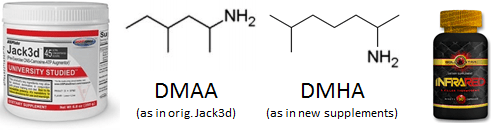
After DMAA, DMBA (AMP citrate) and DMHA (Octodrine) appeared on the market, providing the same effects, which were banned in Australia on October 1, 2017.
The main difference between popular components of pre-training complexes is in the legal field. If DMAA belongs to the semi-forbidden substance, DMHA can be purchased and taken without any legal risk.
There are minor differences in the chemical structure, as for the origin of substances – it is identical. DMAA and DMHA are made synthetically at chemical plants. There are natural sources of DMAA and DMHA, but it is not economically feasible to extract active ingredients from natural raw materials.
According to a [Harty et al., Journal of the International Society of Sports Nutrition, 2018] review on multi-ingredient pre-workout supplements, emerging stimulants like DMHA share structural similarities with DMAA, acting as aliphatic amines that “can function as reuptake inhibitors of norepinephrine and dopamine, potentially increasing energy expenditure and suppressing appetite,” though their long-term safety profiles remain largely unestablished compared to traditional ingredients like caffeine.
DMAA and DMHA: the mechanism of action and effects
The mechanism of action of geranamine and Octodrine is identical, it is connected with the accumulation of mediators (dopamine, noradrenaline) in synapses of the central nervous system. The increase in the concentration of biogenic amines in the brain is accompanied by exacerbation of perception, excitement, improved mood, increased physical and mental performance.
The increasing concentration of mediators in the centers of the spinal cord leads to the pre-activation of motor neurons and increased muscle activity.
Why there are so many contradictions?
“Geranium extract”, namely, the way they present DMAA and so on, has as much in common with natural geranium as vitamin D with injected testosterone. All the above supplements are synthetic.
All these active substances are several times more powerful nervous system stimulants than caffeine, which in itself is quite a good stimulant.
DMAA and other “extracts” are not only powerful but also enhance the action of related stimulants such as caffeine or taurine.
Side effects
If you take the formula of the DMAA pre workout product without “super active substance”, they are quite harmless – it’s just a mixture of vitamins, amino acids, caffeine, and other things. Discomfort can only create beta-alanine, as it can cause some minor tingling or itching in the body.
If you will add DMAA, a powerful stimulant of the nervous system, you can get the following side effects (especially if abuse it and use higher dosage than specified in the manufacturer’s instructions):
- Shudder
- Sweatiness
- Mental Excitation
- Insomnia
- Nausea
- Headache
- Higher blood pressure, tachycardia, stroke (in case of a significant excess of the recommended dose)
- Dry mouth
- Anxiety
- Central nervous system problems
According to a [Karnatovskaia et al., Clinical Journal of Sport Medicine, 2015] case report, the ingestion of DMAA-containing supplements can precipitate severe cardiovascular events even in young, healthy individuals, documenting a case where “a 21-year-old man suffered cardiac arrest after ingesting a dietary supplement containing 1,3-dimethylamylamine,” highlighting that the sympathomimetic toxidrome can lead to life-threatening complications.
For 10 years of sports activity, I have tried DMAA pre workout complexes only 4 times. All 4 times from different companies and all 4 times the effect was the same: shiver, loss of concentration, an increase in blood pressure. Plus, regular use of DMAA pre workout may well develop an addiction and without them, you will be just a sluggish sadness in the gym.
In Conclusion
Paracelsus said:
“All things are poisons, for there is nothing without poisonous qualities. It is only the dose that makes a thing poison.”
It should be clearly understood that any product can do more harm than good if it is abused or misused. Besides, it is worth checking beforehand that there are no medical contraindications to the use of a particular product.
The purpose of this article is to show the other side of DMAA pre workout complexes, which is different from marketing speeches and descriptions on the Internet. Nothing may happen to you from a single use of DMAA pre workout product, but with regular use, you can expect side effects with a very high probability. Be always careful to check any information you receive (even this article).
References:
- Epidemiology (2008) – “Use of a Prescribed Ephedrine/Caffeine Combination and the Risk of Serious Cardiovascular Events”
Analyzes the cardiovascular risks associated with ephedrine use. “Adverse cardiovascular events were more prevalent among cases than among users of ephedrine in general,” supporting the FDA’s rationale for removing uncontrolled ephedra alkaloids from the supplement market.
https://pmc.ncbi.nlm.nih.gov/articles/PMC2565736/ - Journal of the International Society of Sports Nutrition (2018) – “Multi-ingredient pre-workout supplements, safety implications, and performance outcomes: a brief review”
Reviews the safety and efficacy of pre-workout ingredients, noting that aliphatic amines like DMHA share structural and functional similarities to DMAA. It highlights that while these compounds may increase energy, “further information is required regarding long-term efficacy and safety” due to their potent sympathomimetic nature.
https://pmc.ncbi.nlm.nih.gov/articles/PMC6083567/ - Clinical Journal of Sport Medicine (2015) – “Cardiac Arrest in a 21-Year-Old Man After Ingestion of 1,3-Dimethylamylamine-Containing Workout Supplement”
Documents a severe adverse event in a healthy young male. “This case highlights the importance for clinicians to be aware of the potential harm of the DMAA-containing products,” confirming that use can lead to cardiac arrest, hemorrhagic stroke, and death.
https://pubmed.ncbi.nlm.nih.gov/24878759/
Related Posts:



The BoostHormone Research Team is a collective of fitness researchers, nutrition specialists, and health science professionals dedicated to providing evidence-based information about hormone optimization and performance enhancement.
With expertise in sports nutrition, endocrinology, and supplement science, our team analyzes peer-reviewed research and clinical studies to deliver honest, science-backed insights. We cut through industry hype to provide the accurate information you need to make informed decisions about your health and performance.
Our mission: translate complex scientific research into practical, actionable guidance – always prioritizing your safety and long-term wellness. Read Our Editorial Guidelines.