There can be many reasons behind your weight gain. It is not always due to overeating but there are other reasons too such as hormonal imbalance.
Some women blame their weight gain on low estrogen production during their menopause phase. However, that is not entirely accurate. Research shows that menopause-related weight gain is multifactorial, involving decreased physical activity, stress, sleep disruption, and hormonal changes—not solely estrogen levels.
According to research published in the [University Hospitals, 2023], “The number one reason for increased belly fat is a decrease in physical activity, but for women in the menopause transition, there are almost always other factors at play, including hormonal changes, stress levels, dysfunctional sleep patterns and some medications.”
One of the main reasons for gaining excessive belly fats is Human Growth Hormone or HGH. HGH is a critical metabolism regulator that controls how your body breaks down and utilizes fat stores. When HGH production becomes low, it is unable to stimulate your metabolism rate effectively.
According to [Sharma et al., PMC NIH, 2018] research on growth hormone mechanisms, “Growth hormone (GH) has long been known to stimulate lipolysis,” which is the metabolic breakdown of stored fat into free fatty acids and glycerol that your body can utilize for energy.
This decline in HGH-induced lipolysis leads to the accumulation of fats in your body, particularly in the abdominal region. This is why we are able to figure out a connection between weight loss and HGH injections and HGH supplementation.
Deficiency of HGH hormones is one of the major causes that lead to weight gain in middle-aged women, particularly visceral (abdominal) fat accumulation. If you are unable to lose weight despite putting in all the effort and also you have other symptoms of HGH deficiency then you already know the reason. In this article, we will find out important details about the HGH fat loss cycle.
HGH For Women’s Weight Loss – What To Expect?
If you are into sports then you already know about human growth hormone. But what you don’t know is that it is a natural testosterone booster which is produced on its own. HGH has a lot of benefits to offer but before that let’s learn what exactly it is.
Human growth hormone is produced in the pituitary gland in our body. The natural production of this hormone has a major role to play in growth, cell generation and maintaining healthy tissue of various organs including the brain. When HGH is secreted, it remains active for a couple of minutes in the bloodstream. This gives enough time for the liver to change it into growth factors.
It’s been 100 years that human growth hormone has been a subject of study for the researchers. They developed synthetic human growth hormone for the first time in the 1980s. It was then approved by the FDA for specific uses in adults and even in children.
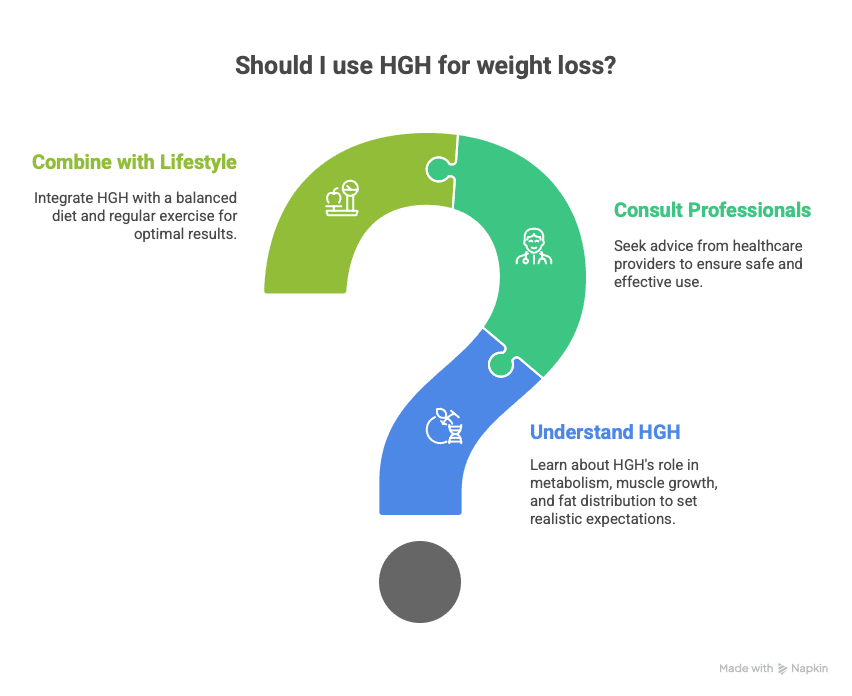
It is believed that HGH can lead to weight loss in women. Growth hormone is known to accelerate lipolysis which means the breakdown of lipids. This includes hydrolysis of triglycerides into fatty acids and glycerol. Impaired secretion of HGH is known to cause loss of lipolytic effect. Dietary restrictions along with HGH treatment effects on lipolytic and anabolic actions work synergistically to enhance fat loss while preserving muscle.
The changes in insulin and HGH secretions were studied and published in clinical research. A landmark 12-week randomized, double-blind, placebo-controlled study examined 24 obese participants (22 women and 2 men, ages 22–46). All participants followed a hypocaloric diet while half received recombinant HGH treatment and half received placebo.
According to [Yonsei University Research, 1999], “GH treatment caused a 1.6-fold increase in the fraction of body weight lost as fat and a greater loss of visceral fat area than placebo treatment (35.3 vs. 28.5%, p < 0.05). In the placebo group, there was a loss in lean body mass (-2.62 ± 1.51 kg)… GH treatment did not result in lean body mass loss but rather preservation and gain of muscle tissue.”
The results demonstrated that HGH treatment leads to enhanced fat loss during caloric restriction. The loss of visceral fat was significantly higher in the HGH-treated group compared to placebo.
Lean body mass was lost in the placebo group. On the other hand, lean body mass was gained in the hormone group. The study showed that participants who were on a caloric restriction diet, HGH accelerated the loss of body fats while preserving muscle tissue. Not just that but it also improved the secretion of HGH. Thus, it can be stated that HGH can serve a therapeutic role to help you lose weight. It can be said that HGH for women’s weight loss is actually effective, with clinical evidence supporting its use under medical supervision.
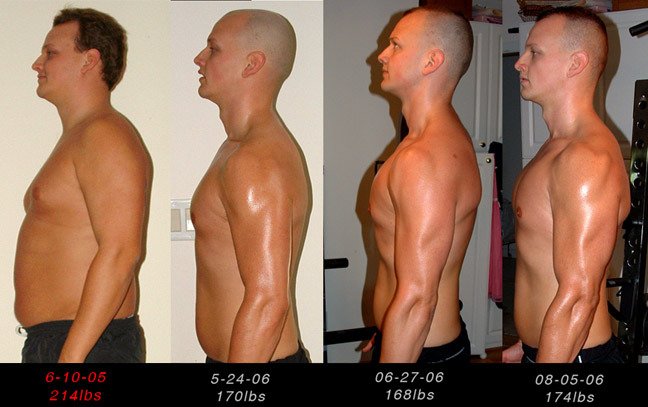
HGH For Weight Loss Before & After
HGH can prove to be effective in weight loss. But before you decide to take the hormones, you should know about the HGH for weight loss before and after effects.
HGH treatment can be self-administered but if you are taking it for the first time, it is important that you consult your doctor.
This is important because you may not be sure about the dosage. Taking a higher dosage of HGH can lead to several problems or side-effects. Therefore, you need to be very careful with the dosage.
There is no doubt that HGH can help you lose weight over time. But at the same time, it also comes with many side-effects. The side-effects tend to vary from person to person. Not just that but both men and women can show different side-effects. The main side-effects that can be seen in adult women include:
According to [HealthOn, 2025], common HGH side effects in women include “joint pain, swelling in hands and feet due to fluid retention (edema), frequent headaches, and muscle discomfort. These side effects often come from fluid retention or changes in hormone levels and usually decrease when the dose is adjusted and monitored by a healthcare professional.”
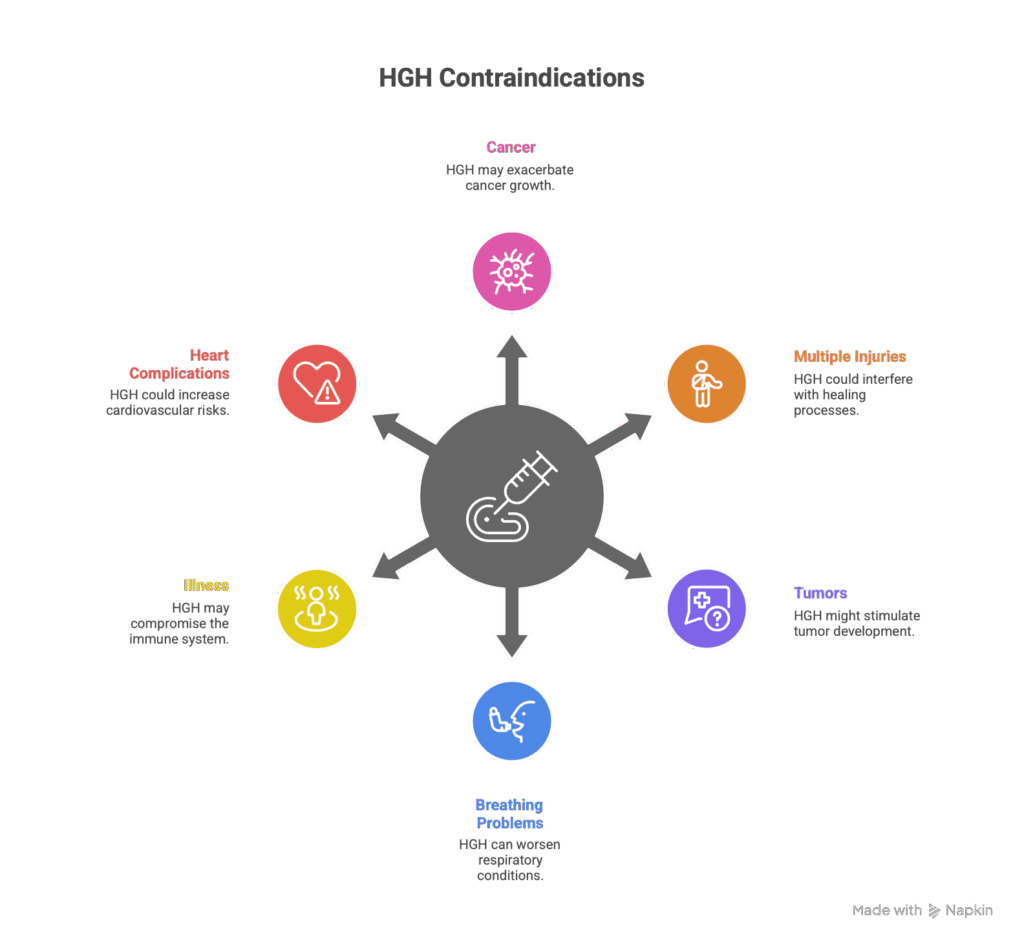
HGH hormones are not recommended for people who have:
- Cancer
- Multiple injuries
- Tumors
- Breathing problems
- Illness
- Heart complications
Now that you know all this you should consider consulting a doctor before taking HGH hormones. You want to get benefitted from it and not suffer because of it.
HGH For Fat Loss Dosage
Before you think of taking HGH injections you need to know the right HGH for fat loss dosage.
According to clinical guidelines, dosing should be individualized based on clinical response and IGF-1 levels. The typical starting dose for fat loss applications is 0.3-0.6 IU per day, which can be gradually increased.
According to [Growth Hormone Research Society Guidelines], “Dosing should start with a low dose, then gradually increase to the minimal dose that normalizes serum IGF-I levels and improves symptoms, without causing unacceptable side effects. Dose escalation typically occurs at 1- to 2-month intervals, with increases of 0.3-0.6 IU per day based on clinical response and individual factors.”
Individual response varies significantly, so professional medical supervision is essential.
2 IU HGH For Fat Loss
You need to know the right dosage of HGH hormones so that you can make the most of it. According to experts, the correct dosage of taking HGH for fat loss can range from 1-2 IU daily. For women, the dosage typically does not exceed 2 IU per day, as this is considered a safe upper limit for fat loss protocols. 2 IU HGH for fat loss can be really effective for your body. However, you should still consult your doctor once before you start taking the dosage to ensure it is appropriate for your individual health status and goals.
1 IU HGH For Fat Loss
The human body tends to adapt with time. Therefore, you should always begin with the minimum dosage in the beginning. In that case, 1 IU HGH for fat loss is just fine for ladies. You can increase your dosage gradually after 1 or 2 months. But before that, you should obviously consult your doctor. This is just for your safety so that you don’t have to suffer from any serious side effects.
Where to buy HGH Online Safely?
You can get HGH-191AA by visiting PureRawz and using the code “Purehormone“ for a 20% off!
With the correct dosage of HGH, you can lose excess body weight over time. But at the same time, you also need to be aware of the side effects. In case, if you have any of the above-mentioned problems you cannot take HGH as it can really harm your health badly. So, if you want to start producing more of your own GH naturally and safely, then growth hormone releasing supplement GenF20 Plus or other top HGH boosters would be your best choices.
References
- Sharma et al., PMC NIH (2018) – “Growth Hormone Controls Lipolysis by Regulation of Fat Specific Protein 27” Demonstrates that growth hormone acutely induces lipolysis in adipocytes through reduction of FSP27 expression. This provides the molecular mechanism explaining how GH stimulates the breakdown of stored triglycerides into free fatty acids and glycerol. https://pmc.ncbi.nlm.nih.gov/articles/PMC6226059/
- Yonsei University Research (1999) – “Low-dose growth hormone treatment with diet restriction accelerates body fat loss” A 12-week randomized, double-blind, placebo-controlled trial with 24 obese participants (22 women and 2 men) showed that GH treatment caused a 1.6-fold increase in the fraction of body weight lost as fat, greater loss of visceral fat area (35.3 vs. 28.5%), and preservation of lean body mass compared to placebo. https://yonsei.elsevierpure.com/en/publications/low-dose-growth-hormone-treatment-with-diet-restriction-accelerat
- University Hospitals (2023) – “The Connection Between Menopause and Belly Fat” Provides evidence that menopause-related weight gain is multifactorial, with decreased physical activity being the primary factor, along with hormonal changes, stress, sleep patterns, and medications—clarifying that weight gain is not solely due to estrogen decline. https://www.uhhospitals.org/blog/articles/2023/08/the-connection-between-menopause-and-belly-fat
- Journal of Clinical Endocrinology & Metabolism (2005) – “Growth Hormone Treatment and Visceral Fat in Postmenopausal Women” Demonstrates that one year of GH treatment in postmenopausal women with abdominal obesity reduced visceral fat mass, increased thigh muscle area, improved insulin sensitivity, and reduced cholesterol levels compared to placebo. https://academic.oup.com/jcem/article/90/3/1466/2836752
- HealthOn (2025) – “HGH Therapy Side Effects: How to Prevent and Manage” Provides comprehensive information on common HGH therapy side effects in women, including joint pain, swelling, headaches, and muscle discomfort, with emphasis on dose adjustment and medical monitoring to manage these effects. https://healthon.com/blogs/journal/managing-side-effects-of-hgh-therapy-what-you-need-to-know
- Growth Hormone Research Society Guidelines – “Growth Hormone Treatment: Dosing and Monitoring” Provides evidence-based clinical guidelines for HGH dosing, recommending individualized, stepwise titration starting with low doses and gradually increasing based on clinical response, IGF-1 levels, and side effects, with specific dosing recommendations for different age groups and conditions. https://agelessforever.net/anti-aging-news-blog/growth-hormone-treatment-dosing-and-monitoring/
Related Posts:



The BoostHormone Research Team is a collective of fitness researchers, nutrition specialists, and health science professionals dedicated to providing evidence-based information about hormone optimization and performance enhancement.
With expertise in sports nutrition, endocrinology, and supplement science, our team analyzes peer-reviewed research and clinical studies to deliver honest, science-backed insights. We cut through industry hype to provide the accurate information you need to make informed decisions about your health and performance.
Our mission: translate complex scientific research into practical, actionable guidance – always prioritizing your safety and long-term wellness. Read Our Editorial Guidelines.