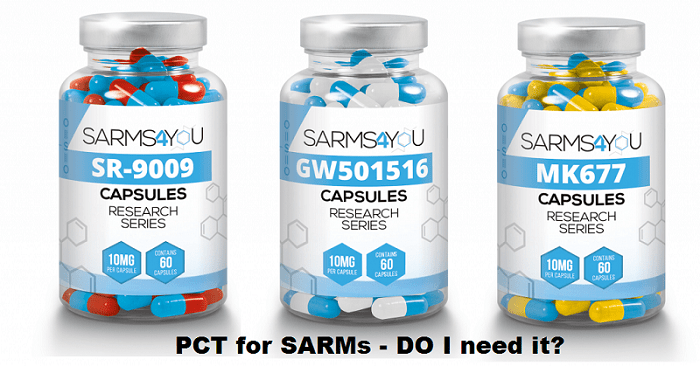
What is PCT?
The PCT (Post Cycle Therapy) is a set of actions that need to be taken to get back the test results to the values they had before the SARM cycle IF they have changed in any way.
These activities help us: maintain and increase health, save lean muscle mass, avoid possible side-effects and unwanted consequences.
Post cycle therapy, that’s something that people do after they go on a cycle of steroids or some SARMs, for example, in general, to bring back their natural production of testosterone. When you take steroids your body doesn’t need to make testosterone anymore because it’s getting it exogenously from another source.
Why you may need SARMs PCT?
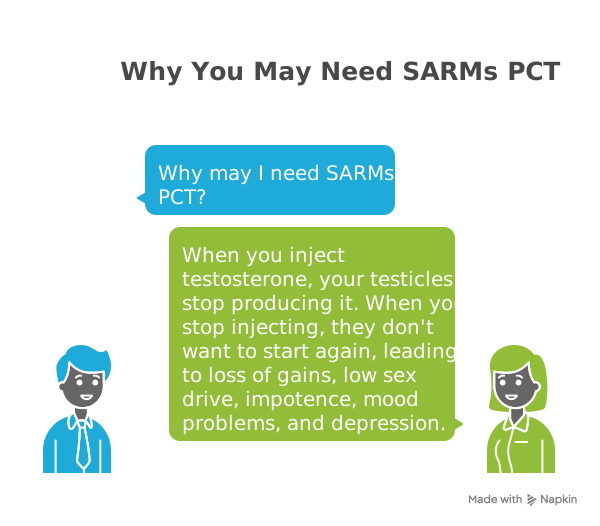
Your testicles go on vacation, let’s just sit back we don’t need to make testosterone anymore while it is being injected every day. You stop injecting and then it’s like oh my God testicles have to go back to work but they don’t want to.
So, as a result, you lose some or all of your gains you feel like shit you have low sex drive you might have even impotence, erectile dysfunction, mood problems, depression, and the list goes on.
According to a [NIH Study, 2023], anabolic-androgenic steroid cessation is associated with significant withdrawal symptoms. Post-cycle therapy use was found to mitigate cravings to restart AAS use, withdrawal symptoms, and suicidal thoughts by approximately 60% each. The study emphasized that “the majority of respondents were concerned about the negative effect of AAS use and cessation,” with most feeling PCT should be prescribed under medical supervision in the community.
The steroid aftereffects are horrible after you come off.1
Do I need PCT supplements after SARMs?
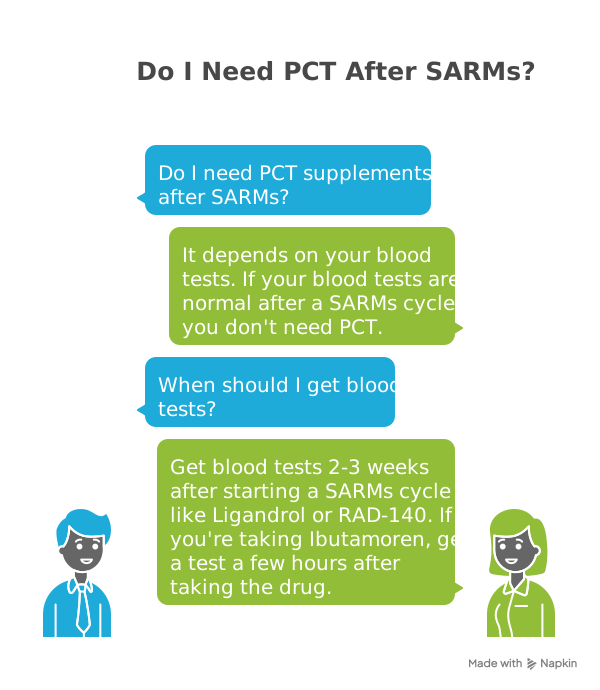
To answer today’s question, the real answer will be – it depends on your blood tests. There’s no yes or no for sure answer to this question as it all depends on your blood tests. If you take a cycle of SARMs and you go to the doctor and you get your blood test done and it is normal, then you don’t need a PCT.
If you are smart and done tests before start taking SARMs, you have a starting point to assess the harm or benefit that the course has brought you.
So, back to our tests. You will do the tests again 2-3 weeks after the start of the cycle, this should only be done in the case of taking SARMs, such as Ligandrol, RAD-140 and similar drugs that work with androgenic receptors. If you take Ibutamoren, for example, the tests should be done a few hours after taking the drug (only one test is needed to be done to check the level of growth hormone in the blood).
Real working SARMs are suppressing the production of own testosterone, LH, and FSH (luteinizing and follicle stimulating hormones). If LH and FSH also fall than your Ligandrol works well!
According to a [Wen et al., 2025] analysis published in Clinical Endocrinology, SARMs demonstrate statistically significant suppression of follicle-stimulating hormone (FSH) and luteinizing hormone (LH), along with decreases in total testosterone and sex hormone-binding globulin (SHBG). The study documented that “SARMs have a positive effect on physical performance and body composition and are associated with moderate rates of mild to moderate adverse effects,” with testosterone suppression being one of the primary concerns requiring PCT intervention.
This is also confirmed by the growth of muscle mass, and SARMs do not affect the liver and blood rheology. Some bodybuilders, to prevent a critical decrease of hormones, are trying to stimulate the production of testosterone by taking test boosters during the cycle. Unfortunately, if SARMs are not fake, it does not help much, so it is better to take those testosterone supplements during PCT.
By the way, the testosterone levels drop, but not to zero, usually hanging somewhere in the lower levels. And if you’re lucky and you’re still young and beautiful, the testosterone level, even after the strong cycle of SARMs, your hormones level may remain somewhere in the middle.
So, if you’re taking Ostarine (MK-2866) less likely that you need a PCT than if you’re taking LGD (Ligandrol).
According to a [Wikipedia Clinical Summary, 2023] review of clinical trials, “LGD-4033 has been found to dose-dependently decrease levels of total testosterone, free testosterone, follicle-stimulating hormone (FSH), sex hormone-binding globulin (SHBG).” A phase 2 clinical trial showed that LGD-4033 increased lean body mass by 4.8% at 0.5 mg/day, 7.2% at 1 mg/day, and 9.1% at 2 mg/day after 12 weeks, making it more suppressive than milder SARMs like Ostarine, thus requiring more aggressive PCT protocols.
How much suppressed you become depends on many factors.
Factors:
The Age
For example, your age matters. If you are 43 you will likely need PCT more compared to someone who is 23.
According to [Handelsman et al., 2022] research published in Reviews in Endocrine and Metabolic Disorders, “in men over approximately 35 years, aging is associated with perturbations in the hypothalamus-pituitary–testicular axis and declining serum testosterone concentrations.” The study notes that older men experience progressively declining gonadotropin-releasing hormone (GnRH) and luteinizing hormone (LH), which significantly impairs their ability to recover testosterone levels post-cycle, making PCT more critical for aging males.
If you’re older your body has a hard time getting back to normal after it has done a steroid cycle. You don’t recover fast, so, the older you are the more likely you need a PCT.
How strong the SARMs cycle was?
The stronger the cycle is the more like you need a PCT. A typical male dosage of Ostarine is 25 milligrams, a typical female goes 10 milligrams. If you’re taking a typical dose the chances are more likely that you’re going to need a PCT. If you’re taking 5 milligrams of Ostarine and I’m taking 50, I have way more chance that I’m going to have problems than the person who is only taking 5! If you push the higher limits then you expect to be needing a PCT.
The cycle length
If you use Ostarine for a year straight chances are you’re going to need to PCT. Use it for 5-10 days you don’t need a PCT. The longer you take it more likely you need PCT. You don’t know for sure unless you get a blood test.
SARMs Stacks
The next thing is stacking SARMs together. If I take Ostarine, S4, RAD-140, and LGD then the chances are you’re going to need a PCT. If not to take PCT you’re going to experience all those bad reactions.
What to take for PCT?
The next question everyone wants to know is what I need to take for SARMs PCT. For example, when you do a PCT you could take something like Clomid or Nolvadex (Tamoxifen). Nolvadex is stronger than Clomid and it is also known as: Citrate, Tamoxifen, ICI 47699 ,ICI-46,474 ,ICI-46474, ICI-47699, ICI47699, Nolvadex, Novaldex, Soltamox, Tamoxifen, Tamoxifen Citrate, Tomaxithen, Zitazonium.
According to [Swolverine, 2025], research demonstrates that “Tamoxifen-induced increases in LH and FSH restore natural testosterone synthesis post-cycle.” Nolvadex works by blocking estrogen receptors in the hypothalamus and pituitary gland, stimulating the release of luteinizing hormone (LH) and follicle-stimulating hormone (FSH), which reactivate the testes’ natural testosterone production and support recovery of the hypothalamic-pituitary-gonadal (HPG) axis.
Although, Clomid has some negative effects such as more problems with mood and some people have visual disturbances.
According to a [Purvin et al., NIH, 1995] clinical study published in peer-reviewed literature, clomiphene citrate can cause prolonged visual disturbances including palinopsia (persistent afterimages), shimmering of the peripheral field, and photophobia. Importantly, the study noted that “unlike previously reported cases, visual symptoms did not resolve on cessation of treatment,” with patients remaining symptomatic from 2 to 7 years after discontinuing the medication, making visual monitoring essential during Clomid use.
It is also known as: Chloramiphene, Citrate, Clomiphene, Clomid, Clomide, Clomifen, Clomifene, Clomiphene, Clomiphene Citrate, Clomiphene Hydrochloride, Clostilbegit, Dyneric, Gravosan, Hydrochloride, Clomiphene, Klostilbegit, Serophene.
Whatever SARMs you’re taking wait a few days for it to get out of your system and then start the PCT!
According to [Swolverine, 2025], “SARMs have very short half-lives,” with RAD-140 having a half-life of approximately 16–20 hours and LGD-4033 ranging from 24–36 hours. This short elimination period means that “the PCT can start just a few days after” completing a SARM cycle, unlike traditional anabolic steroids which may require waiting weeks before initiating post-cycle therapy due to their much longer half-lives.
SARMs have very short half-lives they’re not like weeks or months or any of that stuff like testosterone. So the PCT can start just a few days after.
Use Code “boosthormone15” for 10% discount
3 Typical Options
Option 1
Old school, don’t do anything, it’ll all come back to normal. This is the stupidest and most terrible option, although some hold this view, even taking something stronger than SARMs.
Option 2
Tribulus or complex test boosters paired with vitamins and minerals. To be honest, in 90% of cases, if before the SARMs cycle you had testosterone levels above the average, this can be enough to recover. It’ll only take 2-4 weeks to recover.
- Complex testosterone boosters (they include stimulants for male hormones production and substances that reduce female hormone levels).
- Vitamin and mineral complex from a good manufacturer
- L-carnitine 1.5-3 grams per day – promotes the production of testosterone, is a good anti-catabolic, improves spermogram.
- Omega-3 fatty acids, 2-3 grams per day.
Here’s the minimum list that will allow you to get all the numbers back to normal.
Option 3
PCT. Ideally must be carried out under the control of a doctor or competent specialist. It is the most effective and correct variant which will help you to get the maximum effect to keep and even to improve your health.
According to a [OR25-03 Self-administration Study, 2023] clinical audit from a single addiction service clinic of 613 men stopping AAS in Scotland between 2015-2022, “PCT use was reported by 76% of men,” and men who self-administered post-cycle therapy drugs showed significantly improved biochemical recovery from AAS-induced hypogonadism. The study concluded that “self-administered PCT drugs may be associated with improved biochemical recovery,” with factors including PCT use, fewer AAS compounds, shorter duration of use, and longer recovery time all contributing to successful testosterone normalization.
Well, let’s summarize and make a plan:
- Do the tests before the cycle.
- Do tests during the course (2-3 weeks after the beginning).
- Do tests after the course (1-2 days after taking SARMs).
- Decide on the possibility of the PCT.
- Decide which PCT option to use.
References
- Handelsman, D. J., et al. (2023) “The use of post-cycle therapy is associated with reduced withdrawal symptoms from anabolic-androgenic steroid use: a survey of 470 men” — https://pmc.ncbi.nlm.nih.gov/articles/PMC10640727/ Confirms that PCT use mitigates withdrawal symptoms, cravings, and suicidal ideation by approximately 60% in men discontinuing AAS use.
- Wen, J., et al. (2025) “Selective Androgen Receptor Modulators (SARMs) Effects on Physical Performance and Body Composition” — https://onlinelibrary.wiley.com/doi/10.1111/cen.15135 Published in Clinical Endocrinology, confirms statistically significant suppression of FSH, LH, and total testosterone during SARM use, with moderate adverse effects documented.
- Purvin, V. A., et al. (1995) “Visual disturbance secondary to clomiphene citrate” — https://pubmed.ncbi.nlm.nih.gov/7710399/ NIH-published research documenting prolonged visual side effects of Clomid including palinopsia and photophobia, with symptoms persisting 2-7 years after cessation in some cases.
- Handelsman, D. J., et al. (2022) “Aging and androgens: Physiology and clinical implications” — https://pmc.ncbi.nlm.nih.gov/articles/PMC10370404/ Confirms that older males (>35 years) show perturbations in the HPT axis with declined GnRH and LH, significantly impairing post-cycle testosterone recovery.
- Clinical Summary (2023) Ligandrol (LGD-4033) Clinical Trial Data — https://en.wikipedia.org/wiki/Ligandrol Phase 2 clinical trial results showing LGD-4033 dose-dependent lean body mass increases (4.8%–9.1% at varying doses) with documented testosterone and FSH suppression, confirming higher suppression requiring more aggressive PCT.
- Swolverine (2025) “The Ultimate Guide to Nolvadex PCT: Maximize Recovery and Hormone Balance After Cycle” — https://swolverine.com/blogs/blog/the-ultimate-guide-to-nolvadex-pct-maximize-recovery-and-hormone-balance-after-cycle-6 Confirms tamoxifen’s mechanism in restoring LH and FSH via estrogen receptor blockade in the hypothalamus-pituitary axis.
- Swolverine (2025) “RAD-140 vs LGD-4033 (Ligandrol): Which SARM Builds More Muscle?” — https://swolverine.com/blogs/blog/rad-140-vs-lgd-4033-ligandrol-which-sarm-builds-more-muscle Documents SARM half-lives (RAD-140: 16–20 hours; LGD-4033: 24–36 hours) confirming rapid clearance allowing early PCT initiation, unlike traditional anabolic steroids.
- Self-Administration Study (2023) “Self-administration Of Post-cycle Therapy Is Associated With Increased Probability Of Subsequent Normalisation Of Reproductive Hormones Following Anabolic-androgenic Steroid Cessation In Men” — https://pmc.ncbi.nlm.nih.gov/articles/PMC10555369/ Clinical audit of 613 men confirming that 76% using PCT showed significantly improved biochemical recovery from hypogonadism compared to those not using PCT.
Related Posts:

The BoostHormone Research Team is a collective of fitness researchers, nutrition specialists, and health science professionals dedicated to providing evidence-based information about hormone optimization and performance enhancement.
With expertise in sports nutrition, endocrinology, and supplement science, our team analyzes peer-reviewed research and clinical studies to deliver honest, science-backed insights. We cut through industry hype to provide the accurate information you need to make informed decisions about your health and performance.
Our mission: translate complex scientific research into practical, actionable guidance – always prioritizing your safety and long-term wellness. Read Our Editorial Guidelines.

References:
- NIDA. 2020, June 9. What are the side effects of anabolic steroid misuse?. Retrieved from https://www.drugabuse.gov/publications/research-reports/steroids-other-appearance-performance-enhancing-drugs-apeds/what-are-side-effects-anabolic-steroid-misuse on 2020, July 21